I waited for over 10 years for Duolingo to add my parents’ language so I could learn my mother tongue. It never came, so I built it myself.
My parents are from Ethiopia. They speak Amharic, which is one of over 80 languages spoken in Ethiopia. As a child, my father took me and my brother to the Ethiopian Community Centre on weekends where I struggled (and failed) to learn Amharic.
Fast forward to being a teenager: I was taking French classes and my friends suggested using Duolingo as a supplementary tool to learn French. So I did. At the time, its user interface, gamification, and streak system were one of a kind. It drew me in. Duolingo was a pioneer in edutech. How could learning a language be this much fun?
Using Duolingo to improve my French grade reminded me of reciting ha hoo ሀ ሁ in front of my Dad. I never progressed past simple phrases like dena dere ደህና እደር . Whenever an elder would ask āmarinya tinageralehi? አማርኛ ትናገራለህ? , I’d reply tinish tinish ትንሽ ትንሽ . They’d hear my response and look away in slight disappointment.
I thought surely they must have Duolingo for Amharic. To my immense disappointment, there was nothing. Just a years-old forum post on Duolingo’s website requesting Amharic be added. And on the app store, half-baked applications and iPhone keyboards with Fidel.
That disappointment lingered with me for the past 10 years. On and off I would scope out resources online, to see if there were any new tools or resources to learn Amharic. Nothing that caught my eye. Until now.
In the summer of 2025, I started using vibe coding tools like Claude Code and Codex extensively. I started to see what was possible. Sonora went from an idea to the App Store in 18 days. SteadyTrack was a crisis tool for students 48 hours into Alberta’s teacher’s strike. My mind returned to what I wanted 10 years ago. An application to learn Amharic. So I started building it.
I collected Amharic Anki cards and available PDFs online, and used LLMs to populate the data for this app. LearnAmharic was already taken, so I went with Fidel — the atomic unit of Amharic. After a few sessions with Claude Code, the initial version of Fidel was done. The full Fidel poster as you’d find in any Ethiopian household. Flashcards I could swipe left and right (like dating apps) to test myself. A references tab with vocabulary grouped by category. I even went further and added Selam, an AI assistant specific to learning Amharic. I could have built this from scratch. It would have taken months. Instead it took days.
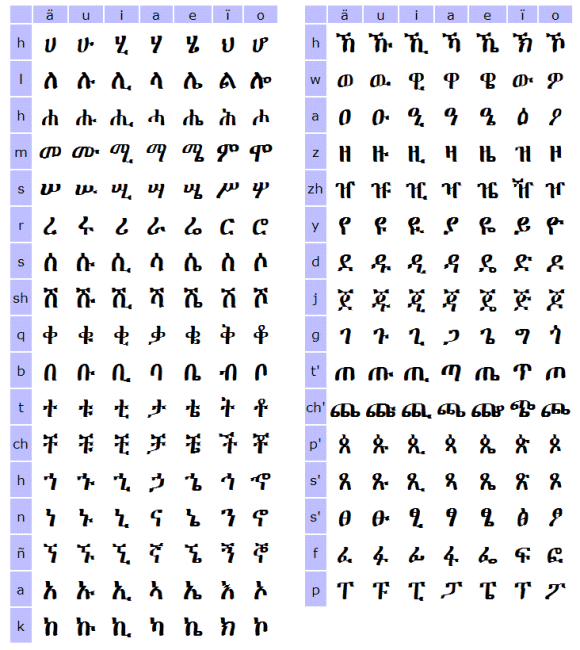
I researched effective ways to actually learn languages. And from that research I gated the curriculum behind stages — which gamified it more but also ensured I wasn’t fooling myself into thinking I was learning. Building Fidel made me realize something about the software I’d been waiting on for a decade.
Duolingo won’t add a learning path for Amharic because it wouldn’t be a profitable endeavour. Amharic is the second most spoken Semitic language in the world. Duolingo still won’t add it. The incentives are misaligned — I want to learn Amharic, Duolingo wants you to keep trying to learn a language. For instance, Duolingo’s energy system costs you energy whether you get answers right or wrong. The only way to keep learning is to watch ads or pay.
Captured software: software whose original function has been compromised by its business model.
Vibe coding serves as an escape from captured software. Before this paradigm shift, you could fork an open source project and augment it as you see fit — but only if you had the technical skills to do it. With vibe coding tools, that barrier is gone. Now, you can spin up applications to fit your needs — no matter how niche. Your application doesn’t need a business model or go-to-market strategy. Simply build with one goal in mind.
That’s the beauty of these tools. I didn’t have to commit months to learning a new tech stack, or block off evenings for weeks before having something functional. Rather, I could envision a goal and how software could be useful in achieving it, and quite literally overnight have something tangible.
My goal was to learn Amharic. And with Fidel, I can now say I know more than tinish tinish ትንሽ ትንሽ .